
Batteries are an essential component of our massive energy infrastructure that allows us to have continuous access to power. They allow for the mass adoption of renewables, provide reliable backup power, and enable more regions of our country to have access to affordable and high-quality energy. However, many people view battery energy storage systems (BESS) as a "black box” – they understand that battery systems can be used to store and discharge energy, but the inner workings of these systems are largely unknown to many. Without diving too deeply into the technical details, this article outlines the fundamentals of BESS, starting with the basic building blocks and working up to the systems that convert DC power from the BESS to usable AC power.
Consider a battery cell as the Lego™ block of the BESS. Cells can be combined in a variety of series/parallel combinations to ensure the BESS delivers sufficient power and is able to store enough energy over time. Stationary BESS can use a variety of different cell chemistries, although LFP – short for Lithium Iron Phosphate – is by far the most common chemistry today. To understand how LFP cells (as well as other chemistries) can convert electrical energy to chemical energy and then bring it back as electrical energy, we’ll need to think back to our Chemistry 101 days.
At their most basic level, all battery cells are comprised of three things: cathodes, anodes, and electrolyte. Cathodes and anodes are types of electrodes, or conductors within a cell, while the electrolyte is the medium through which charged ions can travel. The cathode readily accepts electrons and the anode readily gives off electrons when a battery is discharging. This results in charged ions travelling from the anode to the cathode, creating a potential difference between the battery’s two terminals. If these two terminals are then connected to a circuit, there would be a flow of electrons from the cathode to the anode – this is the usable power from a battery. When a battery needs to be recharged, an external electrical current can be applied to replenish the anode with electrons. This process can be repeated, often thousands of times over the course of a battery’s life.
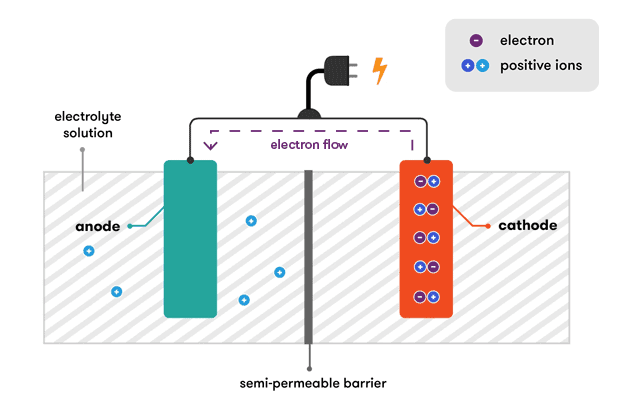
Basic electrochemical diagram of an electrolytic cell (battery cell)
So, how are battery cells connected to the broader system? And how can their charge/discharge be controlled in a safe and precise manner? This comes down to system design, which requires rigorous engineering discipline.
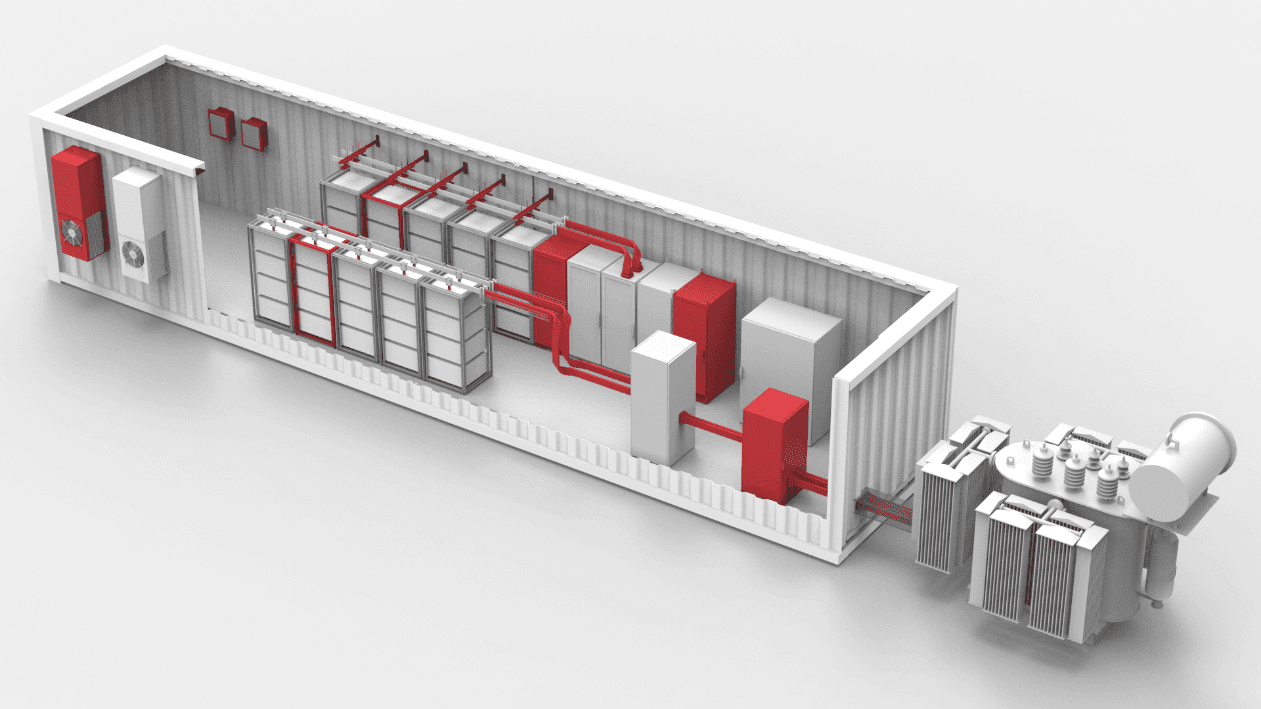
Battery energy storage systems are complex systems that require extensive engineering.
Cell terminals are often ultrasonically welded to busbar, which provides the electrical connection from cell-to-cell. A group of connected cells is often referred to as a module, whose behavior is monitored by a battery management system (BMS). The BMS is responsible for ensuring that all cells are operated in a safe manner and never get to a condition that could allow for a dangerous situation, like thermal runaway. Modules are often mounted on racks and connected to each other in series and/or parallel. Depending on the size of the system, one or more racks will be connected to a power conversion system (PCS), which takes the DC power from the racks and converts it to usable AC power. Let’s take a closer look into how this happens.
The fundamental component of a PCS is the inverter, which converts DC power to AC power. Inverters use transistors to rapidly change the direction of DC current, creating a series of pulses that closely mimic AC power. The size of these pulses is controlled using Pulse-Width Modulation (PWM) and then shaped to form with capacitors and inductors. The result is an AC waveform, much like the AC power that comes out of the power outlets in your home.
At this point, we must make sure that the output AC power is at a usable voltage. In the United States, the most common voltage is 120/240 V. To bring the voltage up or down to this level, battery energy storage systems are often paired with a transformer. Transformers use electromagnetic induction to induce a voltage from a primary coil to a secondary coil. The ratio of turns in the secondary coil relative to the primary coil determines whether the voltage is stepped up or down and to what extent it changes.
Now, we know how chemical energy within a battery cell is transformed into usable AC power. However, what governs this process and ensures it is done in an efficient and optimized manner? The BMS makes sure that cells are operated safely, but it does not optimize the charge/discharge of a BESS in an efficient way. Ultimately, that is the responsibility of the energy management system (EMS). The EMS is essentially the brain of the BESS, telling the batteries when they should and should not be used. A well-designed EMS will ensure that the BESS is able to serve its purpose (whether that is peak shaving, backup power, or otherwise) for years on end.
There are of course many other design considerations that must be factored into a BESS. For instance, thermal management, fire suppression, and switchgear are all integral components of a BESS that deserve an equal amount, if not more, attention than the systems covered in this article. These systems must be rigorously engineered to ensure the BESS can be operated safely and effectively. Get in touch with Alchemy Industrial today to learn more about these systems and the many others that go into optimal BESS design.