
Efficiency is critical for commercial and industrial facilities. An intense focus on efficiency is what allows these facilities to maintain profitability and keep operations running smoothly. This means that their equipment needs to keep running, their throughput needs to stay consistent, and their scrap rates need to be minimized. Any deviation from this has a direct impact on their bottom line.
With that said, C&I facilities often deal with significant inefficiencies when it comes to their use of power – inefficiencies that are sometimes difficult to identify or quantify. The delivered energy to a C&I facility does not necessarily equal the energy that is actually used for productive work. Behind-the-meter energy waste is a function of site efficiency, a variable that is affected by the site’s equipment and the power quality available to the site.
- Equipment Efficiency
Equipment efficiency is fairly easy to understand. Imagine you have a relatively high-power piece of equipment like a pump. In this example, the input power to the pump is 100 kW, meaning that 100 kWh of energy is consumed over one hour. However, not all of this energy goes towards actually pumping a fluid. There are mechanical losses in bearings, seals, and other rotating or oscillating components. There are thermal losses as the pump heats up over time. There are even sonic losses – that loud noise your pump is making is essentially lost energy! After all of these losses, the amount of energy that is actually used to pump a fluid is not 100 kWh, but more like ~90 kWh (if you have a highly efficient pump!).
An important metric to understand here is power factor, which is the ratio of real power (what is used to do work) to apparent power (the total power supplied). This ratio is a function of the reactive power, which is the power that oscillates between the source and the load, not contributing to useful work. Higher reactive powers mean lower power factors. Typically, high reactive powers are caused by inductive loads like electric motors, transformers, etc. Having some reactive power is almost inevitable, but it is best to keep this value as low as possible.
The solution to the equipment efficiency problem is straightforward in theory. When possible, opt for equipment with higher energy ratings. OEMs are increasingly focused on their equipment’s energy rating, since they know that end users are more acutely aware of the impact this has on their electricity bill. When comparing equipment specs, don’t discount the importance of its energy rating. In some cases, you might save money spending a bit more upfront for a higher quality piece of equipment that uses less electricity over time.
- Power Quality
Power quality is an often overlooked variable when it comes to site efficiency, but it is a critical one. In the United States, electricity is commonly delivered to industrial facilities at 480 V (three phase), 60 Hz. However, these are nominal values. In reality, the approximate range of voltage and frequency delivered to your equipment is 440-480 V and 59.7-60.3 Hz, respectively. And it is not a given that the voltage and frequency will be in this range at all times. There are a few scenarios where you might have low quality power delivered to your equipment, which can result in a multitude of issues.
Voltage Sags & Swells
A voltage sag is a short duration decrease in voltage to below 90% of nominal whereas a voltage swell is an increase above the nominal level, often caused by faults or disturbances in the grid.
Transients & Surges
Transients and surges are similar to voltage swells, but they last for just microseconds. These are commonly caused by lightning strikes.
3-Phase System Imbalance
Within a 3-phase system, there are 3 AC power lines delivering power. Voltage imbalance between these 3 lines is fairly common.
Harmonic Distortion
Harmonic distortion is a result of atypical frequencies in an electrical system, which is caused by non-linear loads. In an industrial facility, there are many non-linear loads (i.e. starting up a compressor).
Poor power quality can result in equipment damage, inefficient energy usage, and unsafe working conditions. Unfortunately, this is a common problem in industrial facilities given the outdated grid infrastructure from which they are getting their power. Texas and the Southeast deal with issues like surges on a regular basis, costing C&I facilities billions of dollars each year.
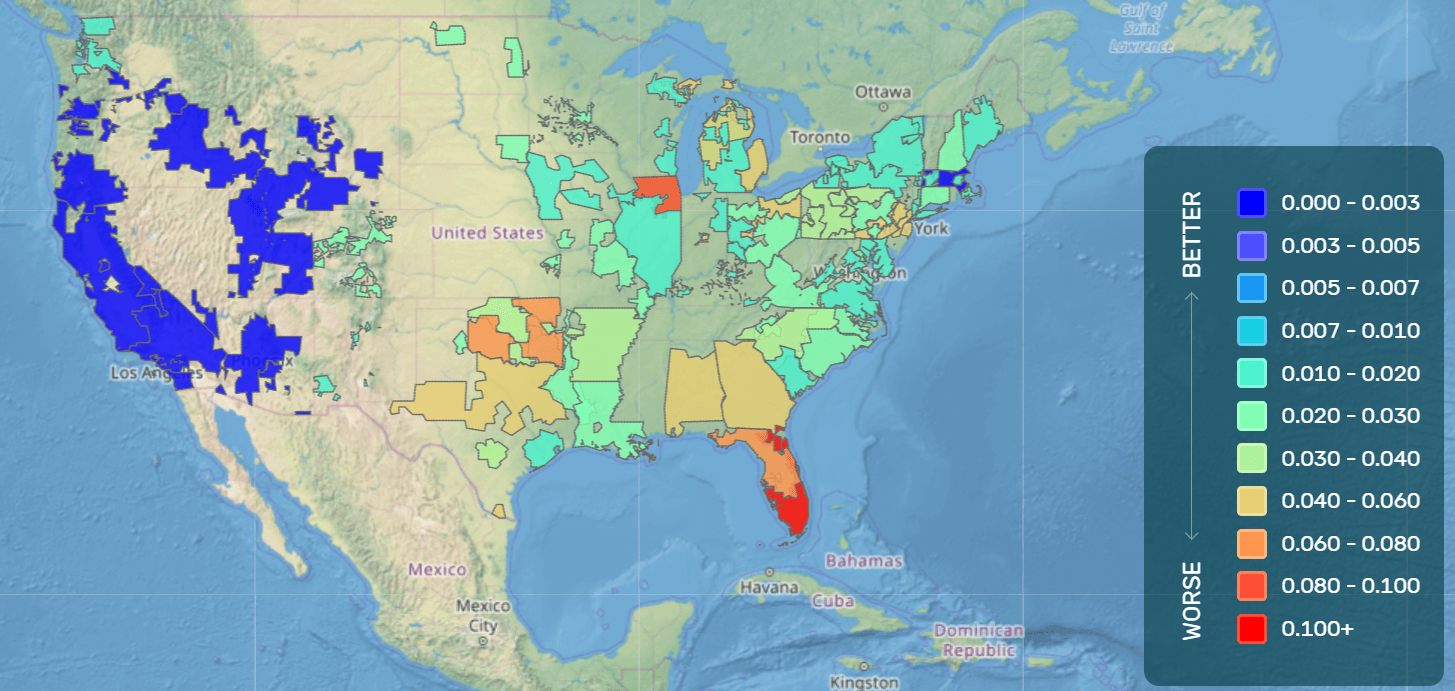
Consumer Power Quality Index (CPQI) measurement of surge frequency by region, June 2025 (Source: Ting)
Battery energy storage serves to mitigate C&I facilities’ exposure to power quality issues. The energy management system of a BESS can provide voltage & frequency regulation, acting as a buffer to ensure reliability. This is a major benefit, considering the fact that power quality issues cost US C&I facilities $15-$24 billion each year. Texas experienced this firsthand in 2021, when ERCOT’s frequency dropped below 59.4 Hz, resulting in mass shutdowns of commercial & industrial facilities.
The next step towards ensuring your facility is safeguarded against power quality issues is simple – get in touch with Alchemy Industrial to schedule your free power quality study. With this study, you can better understand how battery energy storage can support your facility, not just from a power quality perspective, but as a means of backup power, peak shaving, and energy independence.